Monday, February 21, 2011

Do you like to share?


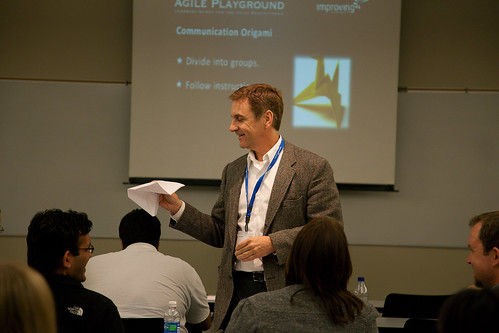
Ken Howard doing his thing


The other day, I witnessed a professional instructor leading a group workshop refuse to let a person observe  the class without fully participating (read: paying). The workshop was focused on active student-teacher interaction, with hands-on work and individual attention being the key elements. A person quietly listening in was not getting anything remotely close to the full benefit of the class, and there was no additional burden on the teachers.  There was plenty of space in the room. Yet, that instructor felt that his work was somehow compromised by someone hearing what he had to offer for free.

It used to be the norm that people would guard their respective tools of the trade from colleagues, to prevent others from “stealing” their jobs. A database specialist would smile mysteriously when asked to please use SCM for his scripts, and a sales person would take her Rolodex home every night. Coders would get upset if others wanted to review their code, or ask permission to watch over their shoulder.

It seems that a lot of people in software industry have moved on to become more open about their work. We write blogs and produce podcasts to share hard-acquired knowledge, participate in question–answer forums to help others, and deliver talks at various user groups to all who cares to listen. Code reviews, while are not exactly industry standard just yet, are widely deployed in more progressive environments and are rarely considered disrespectful in and of themselves.

The perception of what is a skill has recently shifted from what a person owns – bits of knowledge and ideas – to what a person can do with these knowledge and ideas.  The skill is what enables a person to provide value, either by applying his knowledge and ideas to creating or improving a product directly, or by sharing with others.

As for the teacher who refused to let the person observe the workshop, he is well behind the times. And he lost a potential student that day.

Top Secret


AGILEDOTNET 2011 | Houston, TX – February 25th, 8am – 5pm | Register today www.agiledotnet.com

Thursday, November 18, 2010

conversation in an airport


I heard this story while waiting for our flight to Houston. All characters live in Houston, Texas, where steak is king, heart disease is a major factor in 40% of all adult deaths, and donuts are 132% more popular than the US average.
Mmm...steak with ancho sauce and southwestern potatoes

''- I went out with my college roommate, his wife, and his wife's boss’ Grandpa, and he turned out to be a very interesting guy.  He has invested his money into a California outfit that claims to cure cancer by changing a patients diet.  The idea is that if people stop feeding the cancer by eating meat, dairy, juices, alcohol, any processed food, additives - anything, really, but raw and whole fruits and vegetables - the cancer will go away.  So, he said he had been eating this way for the last 10 years.

- He had a lot of energy and slept wonderfully. His allergies disappeared since he started eating this way. He has not been sick in years. He immensely enjoyed the taste of the stuff that he was allowed to eat, and did not miss the food that he was not allowed to have.

- The body is capable of producing all the proteins it needs, there is no reason to eat animal products.  Adults should not be eating dairy; it is for young kids only.  Vegetable juices and oils are not allowed, nor are products of fermentation (wine), distillation (spirits) or refinement (sugar), chemical additives (salt), or any kind of processed food (chocolate, cereal).

- I did this diet for a month, and never in my life had I liked the taste of spinach so much.  I could tell the difference in taste between different leaves in a bag of mixed spring greens.  My favorite snack was a leaf of spinach wrapped around a piece of Clementine or tangerine and an almond slice. Just as an experiment, I tried nicely prepared grilled vegetables with oil and all the fixings.It smelled of burnt oil and tasted disgusting - to me.  (I am sure it was not, though.)

- I found that eating this way has changed my routine. Eating used to take up a certain part of my life, and that part seemed to have disappeared. I was never hungry or full, nor had big meals. Instead, I ate whenever I felt like it, and stopped when I did not want to eat anymore.  I went shopping for fresh produce every day, and found that easy and quick.  I found myself never really thinking about food.

- I don’t know if they can cure cancer with this diet, but I cannot honestly make fun of the old guy who followed it for many years.  Definitely makes for a great story."


fruit (and vegetable) salad

Monday, November 8, 2010

Team communication dynamic over time


Surfers
When a team is first put together to work on a complicated project, it is always very important to develop a shared vision of the project, build relationships within the team, and otherwise establish communication between people working together.  The best, and probably the only, way to achieve that synergy is to have team members communicate face-to-face, many times a day, with minimal interruption needed to reach another person.  This requires that the entire team works in close proximity in both time and space - ideally, common location and similar or heavily overlapping schedule. 

Later on, as the project gets on its merry way, relationships, roles and expectations, and communication patterns within the team get established and become somewhat stable.  Communication over the phone and email becomes more effective as the relationships within the team and motivations of the team members are established.   While talking face-to-face on a regular basis is still invaluable, a lot of work can be done well from different locations and on somewhat flexible schedules among the team. 

In practice, this pattern is often seen in how people approach their new jobs. Many people spend a lot of time in office when they first take a job, and later switch to a more flexible schedule and/or occasionally work from home when possible.

However, for some reason this pattern is almost never seen in software consulting.  The client decides whether they need help in the office, or will consider outsourcing (i.e. let the consultant work on his turf), and make either one the requirement for the lifetime of the arrangement.  Many projects could benefit from better communication early in the engagement, and more flexibility later in the project.