Monday, November 8, 2010

Team communication dynamic over time


Surfers
When a team is first put together to work on a complicated project, it is always very important to develop a shared vision of the project, build relationships within the team, and otherwise establish communication between people working together.  The best, and probably the only, way to achieve that synergy is to have team members communicate face-to-face, many times a day, with minimal interruption needed to reach another person.  This requires that the entire team works in close proximity in both time and space - ideally, common location and similar or heavily overlapping schedule. 

Later on, as the project gets on its merry way, relationships, roles and expectations, and communication patterns within the team get established and become somewhat stable.  Communication over the phone and email becomes more effective as the relationships within the team and motivations of the team members are established.   While talking face-to-face on a regular basis is still invaluable, a lot of work can be done well from different locations and on somewhat flexible schedules among the team. 

In practice, this pattern is often seen in how people approach their new jobs. Many people spend a lot of time in office when they first take a job, and later switch to a more flexible schedule and/or occasionally work from home when possible.

However, for some reason this pattern is almost never seen in software consulting.  The client decides whether they need help in the office, or will consider outsourcing (i.e. let the consultant work on his turf), and make either one the requirement for the lifetime of the arrangement.  Many projects could benefit from better communication early in the engagement, and more flexibility later in the project. 

Wednesday, November 3, 2010

Canadian drugs, Russian hackers and multi-level marketing


Chester Wisniewski, a Senior Security Advisor at Sophos, recently presented a very interesting talk titled "How Hackers Become Millionaires?"(the slides should be available shortly) to the Texas A&M IT community.  While Chet did not present any clear path to making millions, he did discuss how hacking has morthed into and merged with traditional business in the recent years.

According to Mr.Wisniewski, the most targeted cyber attacks of various kinds targeted toward American internet users come from Russia.  It makes certain sense: Russia has excellent technical education, poor job prospects, and not much love for Americans.

The hacker himself (most are men) is only a tiny piece of the cyber fraud business, who is learning about vulnerabilities and building software exploits.  The hacking software is distributed via various channels - in some cases a legitimate site is modified to redirect users to download a trojan, but more often users are enticed to download an executable from a respectable-sounding site via clever advertising.   Social engineering is king, and most internet users remain clueless as to what is really running on their computers, and where their browser takes them.

One of the larger internet fraud enterprises in Russia is Partnerka - a multi-level marketing conglomerate that distributes drugs, porn, adult toys, bogus anti-virus software, counterfeit luxury items and other high-margin items.   Some nodes in the network are open to the general public, and use advertisement on legitimate blogs and forums inviting people to join reseller network and earn commissions by generating traffic to and orders for the stuff.  Other nodes are by-invitation-only, where an existing user must provide a referral for a new affiliate.

A huge portion of Partnerka-affiliated sites offer cheap Canadian drugs.  There are dozens of similar-looking but not quite identical domains peddling generic drugs at too-good-to-be-true prices.  A few even deliver the pills - usually manufactured in India by unlicensed and unregulated sweatshops.   More often the ordered goods never arrive, which is actually safer for the purchaser.

Like many other multi-level marketing schemes, Partnerka is a golden egg only for those at the top of the sales piramid.   A hard-working talented affiliate can make up to $200/day in sales commisions - hardly the millions advertised.   Those affiliates selling trojan downloads and fake dating services make more than the sellers of the physical goods which require shipping.  In both cases, most of the money trickle up to the top of the organization, to the very secretive group that owns the network.

Here's a paper by another Sophos researcher, Dmitry Samosseiko, about Partnerka with a surprisingly cheerful conclusion about working with law enforcement to bring down the fraudsters.

P1030904

Monday, October 11, 2010

For the love of MSDN


I have been going through much .Net framework documentation on MSDN site lately.  I am also working on lock-picking - not any particular lock, just trying to learn a skill.
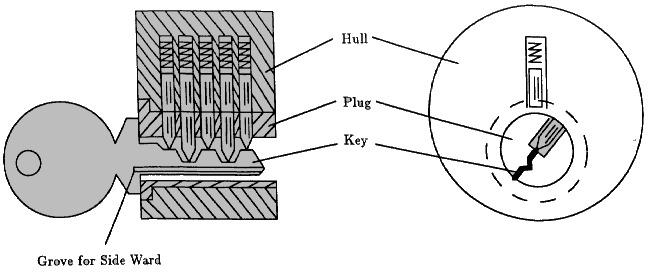
Exhausted from both those activities, and the HoustonTechFest (which was excellent), I came across a very interesting publication entitled The Document Which Used To Be Called The MIT Lockpicking Guide. In simple text with a few black and white pictures this document describes a physical object (a simple lock), it's construction, properties and behavior, and, finally, expected imperfections and analysis of their effect on properties and behavior of the lock. Then it goes on to describe a technique to pick a lock based on understanding of the lock's properties and behavior.
Thinking back to MSDN documentation with the AJAX, 6+colors color-scheme and many different icons and cryptic text, it delivers a lot less information both per square inch and per minute spent reading it. What would it take to have software documentation that shows the big picture, the particulars, the unexpected effects - in plain English, pages that load quickly, and perhaps enough colors to make the page look pleasant but no more?